
Historic Sites
The Virgin Islands have a long and cosmopolitan history, from the native Taino-Arawak, and later Carib peoples, to Columbus, and on to be ruled or claimed by Spain, the Netherlands, England, France, the Knights of Malta, Denmark, and finally, the United States. Couple the impact of the various European influences with the African music, foods, and dances brought to the islands by slaves, and you get a colorful, dynamic, and vibrant culture.
Historic St. Croix
Saint Croix is the largest of the three U.S. Virgin Islands. It lies 65 miles southeast of Puerto Rico and 40 miles south of St. Thomas and St. Johns, the other two members of the USVI. The western part of the island has hills running parallel to the coast, and here you'll find the two highest points on the island - Mount Eagle (1,088 feet) and Blue Mountain (1,096 feet).
The town of Christiansted, on the northeastern coast, is the capital, but Frederiksted, on the western coast, is commercially more significant.
St Croix boasts incredibly diverse influences on its culture. The island was first inhabited by native peoples beginning roughly 2,000–2,500 years ago. These people were the Igneri and later the Taíno tribe. The Taíno were the "Island Arawaks". They were the descendants of mainland Arawak groups who migrated northward into the Caribbean over centuries.
The Taíno were followed later (early 1400s) by the Kalingo (also called Carib people), from whose name the Caribbean Sea is named, and who had migrated northward from South America, taking control of the island from the peaceful Taíno inhabitants who had lived there previously. Historically, this was often framed as a brutal, one-sided eradication. However, modern archaeological evidence and oral traditions from the U.S. National Park Service present a more complex picture of conflict including resource competition and forced assimilation. While many Taíno men were killed or fled to larger islands like Puerto Rico, many Taíno women were taken into Kalinago (Carib) society, creating a blended domestic culture where men and women reportedly spoke different dialects.
One of the most important archaeological areas is Salt River Bay, on the north shore. It was a major Indigenous settlement long before Columbus. Salt River offered a protected harbor, freshwater, fertile land, abundant fish and shellfish, and easy access by canoe to the wider Caribbean. The Taíno lived around the bay for many centuries, and it appears to have been more than an ordinary village—it may have been an important ceremonial and trading center. Archaeologists discovered there the only known Indigenous stone-lined ceremonial ball court (batey) in the Lesser Antilles. Following their conquest, the Kalinago took over Salt River Bay on the northern coast of St. Croix. This vital harbor, which had been a spiritual and ceremonial center for the Taíno, was transformed into a heavily fortified Kalinago village. From this base, Kalinago war parties launched continuous maritime raids against the Taíno in Puerto Rico and the Virgin Islands to capture resources, territory, and captives.
Visit the Salt River Bay National Historical Park and Ecological Preserve. This is a 1,015
acre park on the North Shore of St. Croix. Prehistoric and colonial-era archeological sites
and ruins have been found here. In addition, the tropical ecosystem supports threatened
and endangered species. Salt River Bay holds some of the largest mangrove forests in the Virgin Islands as well as coral reefs and a submarine canyon. Also, the Park has witnessed every major period of human habitation in the Virgin Islands.
Salt River has one of only a few remaining bioluminescent bays in the world. These are a natural occurrence caused by a high concentration of bioluminescent micro-organisms
called dinoflagellates. Depending on the night and location, there are actually three
different types of bioluminescent organisms that may be seen in Salt River: dinoflagellates (the most common), glow worms and/or ctenophora (or comb jellyfish). At night, the dinoflagellates are often seen as tiny sparkles or as individual flashes of light as water is disturbed so this is a popular spot for night time kayak tours with one of our St. Croix’s great tour operators.
Just beyond the breaking waves Salt River Bay’s submarine canyon begins, dropping to 350 feet. Its steep nearly vertical walls were cut in 125,000-year-old Pleistocene (Glacial) Epoch limestone when the sea levels were much lower. As a result, the walls of the canyon are alive with corals, sea whips, and other marine life. This makes this one of St. Croix’s most unique dive sites.
Salt River Bay has seen extensive undersea scientific research because it combines coral reef, water clarity, and a submarine canyon. From 1978 to 1989, successive undersea habitats here housed researchers living at a depth of 50 feet for up to 30 days. You can now dive to one of the old hydro labs at Butler Bay. NASA used these undersea missions to test living conditions aboard space stations. In addition, aquanauts using the saturation diving method worked for hours underwater on studies ranging from animal behavior to geology.
Christopher Columbus landed at Salt Bay in 1493 while on his second voyage to the New World, naming the island Santa Cruz, meaning Holy Cross. Because of the fierce resistance and stealth attacks by Kalinago war parties, Spain was unable to safely settle St. Croix. In response, King Charles V issued a royal decree ordering the total extermination of the Caribs. Facing advanced European military campaigns and Old World diseases, the Kalinago were forced to abandon St. Croix by the mid-1500s, leaving the island largely unpopulated until northern European powers began fighting over it a century later. While Spain claimed St. Croix they did not establish a lasting Spanish colony there.
The Dutch and English established settlements on the island around 1625. The two groups initially shared the island uneasily, but, as sugar production became more profitable, St. Croix increased in attraction and conflict followed, and the Dutch were eventually driven out. The Spanish from Puerto Rico then attacked the English settlement in 1650 and took the island. Almost immediately afterward, the French attacked the Spanish and seized St. Croix.
So St. Croix was claimed by Spain, but colonized by both the English and the Dutch , who were then expelled by the Spanish, who in turn succumbed to French conquest. In 1651 the Knights of Malta acquired St. Croix from the French government but resold it to the French West India Company in 1665. It became a French colony in 1674, but by the end of the century the colony was struggling. In 1695, the French government ordered the colonists removed to Saint-Domingue, which is modern Haiti, and St. Croix was then largely abandoned by Europeans for several decades.
The event that most profoundly shaped the St. Croix you see today occurred in 1733. The Danish West India and Guinea Company purchased St. Croix from France. Denmark already controlled St. Thomas and St. John, so St. Croix became the third major island of the Danish West Indies.
This began nearly 185 years of Danish rule. Christiansted was laid out as the colonial capital, and Frederiksted developed on the west side of the island. Much of the beautiful architecture you see in Christiansted today comes from this period - the arcaded buildings, courtyards, yellow masonry structures and streets arranged on a European colonial grid.
The Danes developed St. Croix primarily as a sugar-producing plantation colony which completely transformed both the landscape and population. Large numbers of enslaved Africans were forcibly brought to St. Croix, overwhelmingly from West and West-Central Africa, to work the sugar plantations. By the late 18th and early 19th centuries, people of African ancestry greatly outnumbered Europeans.
Visit the Estate Whim Museum, the only restored sugar plantation museum on the island. It features the iconic stone sugar mill ruin, a Cook House, and the plantation house grounds. It is located near Frederiksted.

This is crucial to understanding St. Croix:
Although the island was politically Danish, the culture that developed was overwhelmingly shaped by African and Afro-Caribbean people. Language, food, music, religious traditions, storytelling, agriculture and social customs all developed under Afro-Caribbean influence.
It also explains something that initially seems peculiar: despite nearly two centuries of Danish rule, English rather than Danish became the everyday language of much of the population. This is probably because the island's commercial and cultural connections were heavily tied to the surrounding English-speaking Caribbean.
During the 1700s, Christiansted became the administrative and commercial center of the Danish West Indies. Its excellent harbor and St. Croix's extremely fertile central plain made the island enormously valuable. At its peak, the landscape would have looked very different from today. Much of St. Croix was divided into sugar estates, with sugarcane covering enormous portions of the island. Those stone windmill towers you see scattered everywhere are remnants of this period.
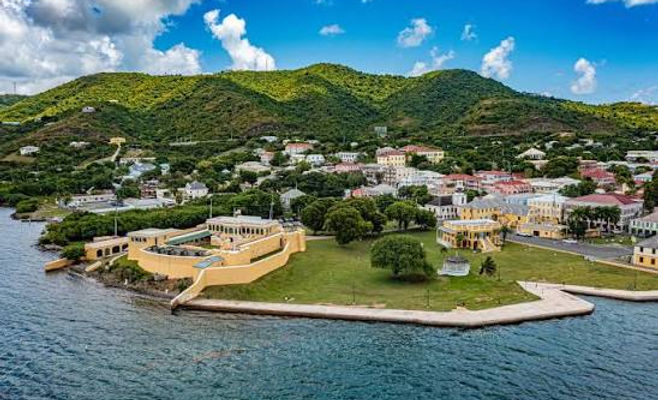
Visit the Christiansted National Historic Site. This is a 7-acre park with the gorgeous
yellow-and-white Danish colonial buildings from the 1700s and 1800s. There is Fort
Christiansvaern which was built in the 1740s and has dramatic harbor views, historic
cannons, and a museum fee of $10 per person (free for kids and military).

There is the Danish Custom House and Scale House, which are historic waterfront
structures used during the height of the island's sugar trade. And there is the Steeple
Building, a former Lutheran church displaying local indigenous artifacts.
One of the most important moments in Crucian history happened in
Frederiksted.
On July 3, 1848, thousands of enslaved people gathered there demanding freedom. The Danish governor-general Peter von Scholten, facing the possibility of widespread revolt, declared the enslaved population free. The proclamation is traditionally associated with the words: “All unfree in the Danish West India islands are from today emancipated.” Slavery in the Danish West Indies was over. But emancipation didn't bring economic equality.
Plantation workers remained subject to extremely restrictive labor laws.
Thirty years later, that produced another pivotal Crucian event.
In October 1878, plantation workers revolted over wages and oppressive working conditions.
Much of Frederiksted was burned during the uprising, which became known as Fireburn.
Four women became legendary figures in Crucian history: Queen Mary Thomas, Queen Agnes, Queen Mathilda and Queen Susanna. Queen Mary in particular remains one of St. Croix's great historical symbols. These women weren't queens in a royal sense. “Queen” was a title of respect and leadership within the community.
Mary Thomas — “Queen Mary”
Agnes Salomon — “Queen Agnes”
Mathilda McBean — “Queen Mathilda”
Susanna Abrahamson — “Queen Susanna”
The women were accused of helping lead and organize groups of workers
during the uprising and encouraging resistance against plantation owners and
the colonial authorities. And this wasn't a small disturbance.

The statue is in Charlotte-Amalie, St. Thomas.
The uprising began around Frederiksted and spread into the countryside. Buildings and plantations were burned, and a substantial part of Frederiksted was destroyed
by fire. Danish authorities eventually suppressed the revolt with military force.
Visit the Fort Frederik National Historic Landmark, the site of the 1848
emancipation proclamation that ended slavery in the Danish West Indies.
Located in Frederiksted on the western end of the island, this striking
red-and-white masonry fort is definitely worth seeing. There is an art gallery,
museum & waterfront park on the grounds.

The Queens were arrested. Mary, Agnes and Mathilda were sentenced to
death, although their sentences were commuted to life imprisonment. They
were eventually transported all the way to Copenhagen, where they were
imprisoned in Denmark before later being returned to St. Croix. And there's another remarkable aspect: working-class Black women became the remembered faces of one of the most important resistance movements in Danish Caribbean history. Susanna was not originally remembered from this event - which is why the statues commemorate The Three Queens instead of four. Susanna's role in the uprising was thought to have just been participating in looting and arson in Frederiksted. For this she was sentenced to death, had that sentence commuted to life at hard labor, and was transported to the women's prison in Copenhagen in 1882. She returned to St. Croix in 1886. It was not until the 2000s that her role as one of the Four Queens was truly understood.
By the early 20th century, the Danish islands were economically declining and Denmark had considered selling them for decades. During World War I, the United States became increasingly concerned that Germany might obtain the islands, which occupy a strategically important position approaching the Caribbean and Panama Canal. The United States agreed to purchase St. Croix, St. Thomas and St. John from Denmark for $25 million in gold. The transfer took place on March 31, 1917, still celebrated as Transfer Day. The islands became the United States Virgin Islands and Crucians - and all Virgin Islanders - were granted U.S. citizenship in 1927.

Visit the St. George Village Botanical Garden which is built among the repurposed ruins of a 19th-century sugarcane plantation village, this lush garden spans 16 acres and showcases thousands of native and tropical plants alongside historical structures. The garden is located near Fredericksted.
